|
私は妹にお金を貸してあげました。 |
I (generously) lent my sister money (to help her
out of her destitute conditions).
|
| watashi-wa imooto-ni okane-o kashite agemashita. |
|
|
私は妹にお金を貸しました。 |
I lent my sister money. |
| watashi-wa imooto-ni okane-o kashimashita. |
|
| |
|
きょうこさんはトムさんを
駅に連れていってあげました。 |
Kyoko (kindly) took Tom to the station (because he
would be lost if left all by himself). |
|
kyooko-san-wa, tomu-san-o
eki-ni tsurete itte
agemashita.
|
|
きょうこさんはトムさんを
駅に連れていきました。 |
Compare: [an objective statement]:
Kyoko took Tom to the
station. |
|
kyooko-san-wa, tomu-san-o
eki-ni tsurete
ikimashita.
|
|
| |
Note that in ageru sentences the nouns
referring on the beneficiaries are accompanied by whatever
particle the main verb calls for.
kasu goes with the
particle
ni, while tsurete-iku goes with wo [o].
These particles are retained in the
ageru sentences.
When you want to add the idea of
"doing somebody a favor" to a verb which does not have the place
for the beneficiary,
you can use ~no tameni. |
私はともこさんのために
買い物に行きました。 |
I went shopping for Tomoko. |
watashi-wa, tomoko-san no tameni
kaimono-ni ikimashita. |
|
| 私は買い物に行きました。 |
Compare: I went shopping. |
| watashi-wa, kaimono-ni ikimashita. |
|
|
| |
|
| |
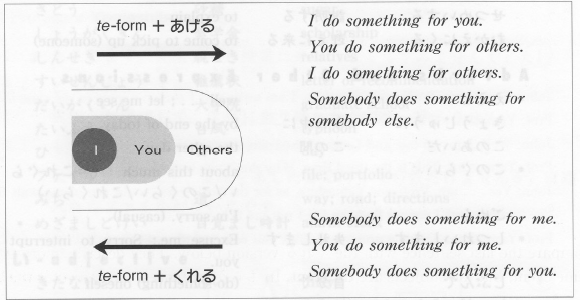
We use くれる - kureru when somebody does something for us. |
| 友達が宿題を手伝ってくれます。 |
A friend helps me with my homework (for
which I am grateful). |
| tomodachi-ga shukudai-o tetsudatte kuremasu. |
|
| 親戚がクッキーを送ってくれました。 |
A relative sent me cookies. (I should be so
lucky.) |
| shinseki-ga kukki-o okutte kuremashita. |
|
| |
|
| |
The beneficiary is almost always understood to
be the speaker in kureru sentences.
Therefore it usually does not figure grammatically.
If you have to explicitly state who received the benefit,
you can follow the same strategies employed in ageru
sentences.
That is, if the main verb has the place for the person
receiving the benefit, keep the particle that goes with it.
The verb tsurete-iku calls for wo [o], while
oshieru calls for ni, for example. |
| |
Thus we can say: |
|
きょうこさんが私を
駅に連れていってくれました。 |
Kyoko took me to the station. |
kyooko-san-ga, watashi-o
eki-ni tsurete itte kuremashita. |
|
| 私を駅に連れていく |
Compare: ... me to the station take.. |
| watashi-o eki-ni tsurete iku |
|
| |
|
たけしさんが私に
漢字を教えてくれました。 |
Takeshi taught me that kanji. |
|
takeshi-san-ga watashi-ni
kanji-o oshiete kuremashita. |
|
| 私に漢字を教える |
Compare: ... me kanji teach... |
|
watashi-ni kanji-o oshieru |
|
| |
|
| |
If the main verb does not have the place for
the person, use ~no tameni.
sooji-suru is one such verb. |
けんさんが私のために
部屋を掃除してくれました。 |
Ken cleaned the room for me. |
|
ken-san-ga watashi-no tameni
heya-o sooji-shite kuremashita. |
|
|
| |
We use the te-form + もらう - morau to say that we get, persuade or arrange for
somebody to do something for us.
The person performing the action for us is accompanied by
the particle ni. |
私は友達に宿題を
手伝ってもらいました。 |
I got a friend of mine to help me with my
homework. |
|
watashi-wa, tomodachi-ni shukudai-o
tetsudatte moraimashita. |
|
| |
Compare the last sentence with the kureru
version below.
They describe more or less the same event, but the subjects
are different.
In morau sentences, the subject is the beneficiary.
In kureru sentences, the subject is the benefactor. |
友達が宿題を
手伝ってくれました。 |
A friend of mine helped me with my homework. |
|
tomodachi-ga shukudai-o
tetsudatte kuremashita. |
|
| |
|
| |
Sometimes, a morau sentence simply
acknowledges a person's goodwill in doing something for us.
For example, you can say the following even if you had not
actively asked for any assistance.
(The sentence is of course
okay with the "get somebody to
do" reading.) |
私は知らない人に
漢字を読んでもらいました。 |
I [am glad that] a strangers read the kanji for
me. |
|
watashi-wa, shiranai hito-ni
kanji-wo yonde moraimashita. |
|